40MM VS. 60MM INSULATION: DOES THICKER ALWAYS MEAN BETTER?
 Paul May
National Luna fridges use high-density injection foam with three insulation bands (37mm, ~40–42mm, and 60mm), where 37mm prioritizes interior volume and 60mm maximizes efficiency, especially for deep-freeze use in high heat or limited-solar setups. Single-zone buyers can treat 37mm as sufficient for compact, fridge-focused installs and step up to 60mm (NL 40, 55, 65, 80, 125, and drawer singles) for dedicated freezer duty or expedition capacity. Dual-zone clients should match zone split and form factor to their vehicle: compact 37mm duals for tight spaces, mixed 40–60mm units (NL 50/60/70/90) for most overland builds, and 60mm double-doors (NL 72/110) or drawer systems when maximum efficiency, separate doors, or integrated drawer installs are the priority.
A practical guide to choosing the right National Luna model for how you actually use your fridge — from compact singles to drawer fridges and the flagship double door.
When you're choosing a National Luna fridge, the insulation question comes up quickly. Across the lineup, wall thickness ranges from 37mm to 60mm. The 60mm option sounds like it should always win — but the reality is more nuanced, and understanding the tradeoffs will help you pick the model that actually fits your rig and how you use it.
Here's what the insulation difference actually means across the full lineup — every model, straight from National Luna's specs.
HOW NATIONAL LUNA'S INSULATION WORKS
All National Luna models use high-pressure injection foam between the stainless steel exterior and aluminum interior. The high-pressure process produces denser, more uniform foam than what standard competitors achieve, which means even 37mm National Luna walls outperform thicker foam in plastic-bodied competitors.
Within the lineup, insulation thickness falls into three bands: 37mm (compact single and dual models), 40–42mm (mid-range singles and the fridge zone of most dual-zone units), and 60mm (all double-door models, the NL 40/55/65/80/125 singles, and all drawer fridges). On dual-zone models with mixed insulation, the freezer-side compartment always receives the thicker walls — National Luna's own documentation recommends assigning the thicker-insulated zone as the freezer for best efficiency.
THE COMPLETE LINEUP: INSULATION AT A GLANCE
All specs sourced from National Luna's official brochure (March 2026 edition). Chest fridges sorted by total volume; drawer fridges grouped at the bottom by volume. On dual-zone models, the left zone is typically the colder/freezer-capable zone unless noted.
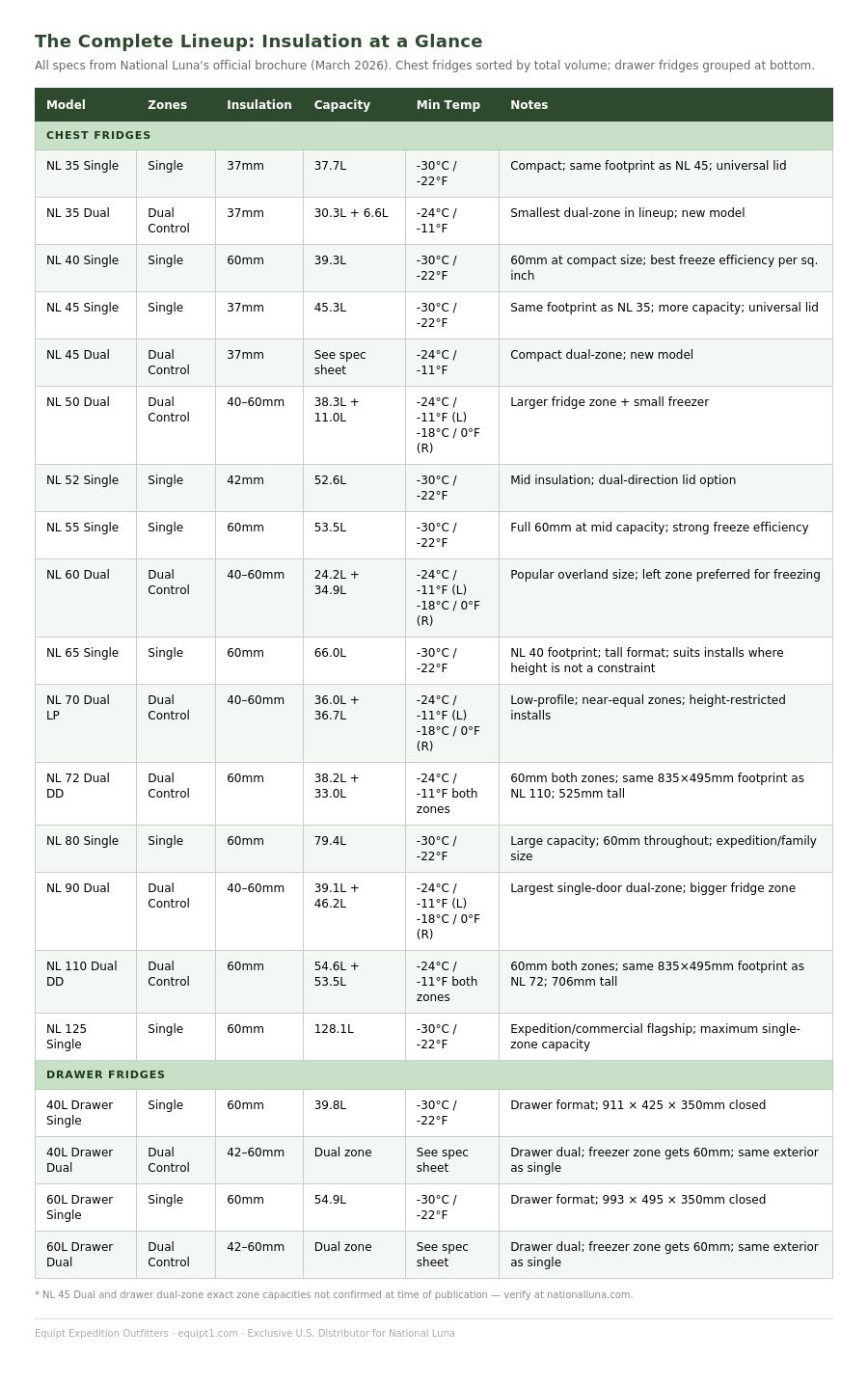
* NL 45 Dual and drawer dual-zone exact zone capacities not confirmed at time of publication — verify at nationalluna.com.
SINGLE-ZONE MODELS: WHERE INSULATION THICKNESS MATTERS MOST
NL 35 and NL 45 Single Zone (37mm)
The 35L and 45L single-zone models share the same exterior dimensions and run 37mm walls — the thinnest in the lineup. Both reach -30°C (-22°F), making them legitimate dedicated freezers despite the thinner insulation. The 37mm walls are a deliberate tradeoff to maximize interior volume within a compact exterior. Performance still surpasses most competitors' thicker but less dense plastic-wall insulation.
Best for: Compact vehicle installs, solo or couples travel, weekend use. The NL 35 single-zone excels as a dedicated drinks fridge or standalone freezer in smaller vehicles.
NL 40 Single Zone (60mm)
The NL 40 is the efficiency benchmark for compact fridges in the lineup: 60mm walls in a small footprint, -30°C capable. Thick walls relative to its volume mean the compressor cycles less than any comparable-size unit.
Best for: Buyers who want the smallest possible exterior with maximum freeze efficiency.
NL 52 Single Zone (42mm)
The 52L sits between the 37mm compact models and the 60mm efficiency leaders at 42mm. Its unique dual-direction lid — switchable front or side opening — makes it particularly useful in tight cargo installs where lid clearance is constrained.
Best for: Installs where lid-opening direction matters, or buyers who want more capacity than the 45L before stepping up to the 55L.
NL 55, 65, 80, and 125 Single Zone (60mm)
All four run full 60mm walls. The 55L is the best seller in this group — full 60mm efficiency in a practical mid-size format that fits most overlanding rigs without demanding a large footprint. The 65L trades a taller profile for more interior volume on the same compact base, which works well in specific installs where height isn't a constraint. The 80L and 125L serve families, expedition groups, and commercial operators who need serious capacity without giving up efficiency.
> At standard refrigerator temps (2–6°C / 35–43°F), the 37mm vs. 60mm difference is minimal in real-world use. The gap opens up meaningfully when running sustained deep-freeze temperatures in hot ambient conditions.
DUAL-ZONE MODELS: THE INSULATION STORY GETS MORE INTERESTING
On dual-zone models, insulation is not equal between the two compartments. The freezer zone gets thicker walls; the fridge zone uses somewhat thinner insulation to preserve volume. National Luna's own documentation recommends assigning the thicker-insulated side as the freezer for best efficiency.
NL 35 and NL 45 Dual Zone (37mm)
The newest additions to the lineup, bringing Dual Control into a very compact form factor. At 37mm, they sit at the thinnest point in the dual lineup, but both reach -24°C (-11°F) on the freezer zone. The NL 35 Dual gives you 30.3L main zone + 6.6L freezer.
Best for: Compact vehicles where dual-zone flexibility is wanted but space is tight. Great for couples who want fresh food and frozen meat simultaneously without running two units.
NL 50, 60, 70, and 90 Dual Zone (40–60mm mixed)
These four models form the core of the dual-zone chest lineup and all use variable insulation. The key difference between them is how the volume is split between zones:
• NL 50 (38.3L + 11.0L):Larger fridge zone, small freezer. Ideal when you predominantly need refrigerator capacity with a small dedicated freeze section.
• NL 60 (24.2L + 34.9L):Left zone preferred for freezing; the most popular overland size in the lineup. Left zone reaches -24°C, right -18°C.
• NL 70 Low-Profile (36.0L + 36.7L):Near-equal zones in a low-profile design built for height-restricted installs. Left reaches -24°C, right -18°C.
• NL 90 (39.1L + 46.2L):Largest single-door dual-zone; bigger fridge zone. Best when you need maximum food storage with freezer capability. Left reaches -24°C, right -18°C.
NL 72 and NL 110 Double Door (60mm on both zones)
The double-door models are in a class of their own. Both use 60mm insulation on every wall, both zones reach -24°C (-11°F), and both share the same 835 × 495mm floor footprint. The only difference is height: the NL 72 is 525mm tall closed and weighs 33.5kg; the NL 110 is 706mm tall and weighs 39.4kg. The extra height is where all the additional volume lives — the NL 110 holds 54.6L + 53.5L versus the NL 72's 38.2L + 33.0L.
The separate doors mean you only open the zone you need, which dramatically reduces cold-air loss and lets the thick walls do their job. For overlanders stepping up from the NL 72, the NL 110 fits the same mounting footprint with no new hardware needed.
> The NL 72 and NL 110 are the only dual-zone models with 60mm on both sides. Every other dual-zone model uses mixed insulation — thicker on the freezer zone, thinner on the fridge zone.
DRAWER FRIDGES: A DIFFERENT INSULATION CALCULATION
Drawer fridges sit low and horizontal in enclosed systems where ambient heat comes from below and the sides. Both single-zone drawer models run full 60mm walls — appropriate for units that live inside enclosed canopies and truck beds where temperatures can spike significantly. The dual-zone drawer models follow the same 42–60mm variable approach as the chest-style dual-zone units.
• 40L Drawer Single (60mm, 39.8L actual):911 × 425 × 350mm footprint. -30°C capable.
• 40L Drawer Dual (42–60mm):Same exterior as 40L single. Freezer zone gets thicker insulation.
• 60L Drawer Single (60mm, 54.9L actual):993 × 495 × 350mm. Same 350mm height, longer and wider. -30°C capable.
• 60L Drawer Dual (42–60mm):Same exterior as 60L single. Best dual-zone option for permanent drawer installs.
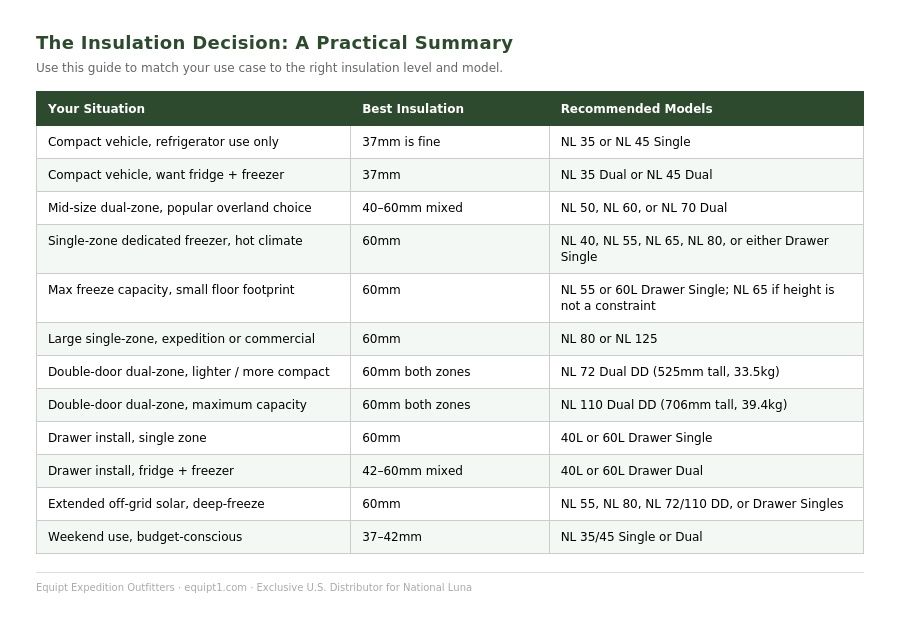
THE INSULATION DECISION: A PRACTICAL SUMMARY
THE BIGGER PICTURE
All of these insulation figures exist within a baseline that most of the competition can't match. National Luna's high-pressure injection foam process — enabled by the all-metal construction — produces denser insulation than the standard pour-in-place foam in plastic-bodied competitors. A 37mm National Luna wall performs closer to a 50mm competitor wall.
The 37mm vs. 60mm question is about optimizing within an already high-performing system. Choosing 37mm is a smart tradeoff for compact installs or refrigerator-only use. Choosing 60mm is the right call when you're running sustained deep-freeze temps, sitting in a hot enclosed space, or relying on limited solar capacity for extended off-grid trips.
> Still not sure which model fits your rig? The team at Equipt has worked through these tradeoffs with hundreds of customers. Call or stop by — we'll get you to the right answer.
THE BOTTOM LINE
For most overlanders, the answer comes down to three models: the NL 50, NL 60, and NL 90. These are our best sellers — and for good reason. All three are dual-zone units with Dual Control technology, letting you run a larger fridge zone alongside a dedicated freezer from a single compressor. They represent the best balance of interior capacity and exterior footprint for the vehicles most of our customers are actually building out. If you're not sure where to start, start here. Shop the NL 50, NL 60, and NL 90 at equipt1.com, or call us and we'll help you dial in the right fit for your rig.