What Size Fridge Do I Need?
 Paul May
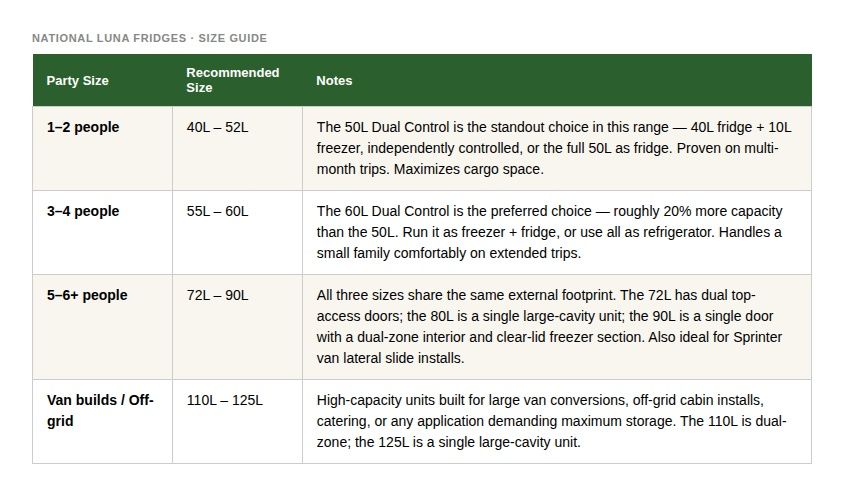
National Luna fridge sizing is simpler than cooler sizing because you eliminate ice, so a smaller liter capacity often holds more usable food than your old cooler. Match capacity to your party and space: 40–52L for 1–2 people, 55–60L for 3–4, 72–90L for 5–6+ or Sprinter installs, and 110–125L for van/off‑grid Systems, choosing Dual Control when you need independent fridge/freezer zones. If you’re between sizes, go smaller when cargo space is tight and larger when you have room and travel with others, and only prioritize 60mm insulation if you plan to deep-freeze regularly.
One of the most common questions we get when someone is looking at a National Luna fridge is: how big should I go? It's a fair question, and the answer isn't always obvious — especially if you're used to thinking in terms of cooler size, not fridge size.
The good news is that choosing the right capacity is straightforward once you understand a few key principles. We've run every size in the National Luna line — on everything from weekend runs up to multi-month expeditions — and this guide distills what we've learned into practical advice you can actually use before you buy.
You No Longer Have to Deal with Ice
The single most important thing to understand when sizing a fridge is this: you are no longer carrying ice. That changes the math significantly.
Ice takes up a substantial portion of a traditional cooler's volume — often a third or more of total capacity — and that ice melts, turning into water that takes up even more space while doing progressively less cooling. When you move to a fridge, that entire volume is freed up for actual food and drinks.
The fridge you need will typically be smaller than the cooler you're replacing —sometimes considerably smaller. Keep this in mind when you start looking at numbers.
A customer who's been running a 60-quart cooler might assume they need a 60-liter fridge. In practice, they often find a 40L or 50L model carries more usable food with room to spare, because every liter is working fridge space rather than ice. As a quick reference: liters and quarts are close to a 1:1 ratio — a 50L fridge is roughly equivalent to a 50-quart cooler in total volume, but with every bit of that space available for food.
Single Zone vs. Dual Control: Which Do You Need?
Before you look at sizes, it helps to understand the two interior configurations National Luna offers — because it affects which models are available to you at each capacity.
Single Zone: A single compartment set to one temperature — run it as a fridge or a freezer. Simple, maximum open-cavity volume, and available in the widest range of sizes.
Dual Control: Two compartments with fully independent temperature control from a single compressor. Each zone is set separately — Fridge/Freezer, Fridge/Fridge, or Freezer/Freezer. Either zone can also be turned completely off when you don't need it, saving power on shorter trips or lighter loads.
Most overlanders choose Dual Control — the ability to freeze meat while refrigerating produce, from one unit, without carrying two separate fridges, is hard to give up once you've used it.
The Size Guide: Matched to Your Party
Here's how we break it down, based on real-world use:
1–2 People: The 40L–52L Range
For a couple, the sweet spot is between 40 and 52 liters. Our personal favorite in this range is the 50L Dual Control — it gives you a 40-liter fridge section and a 10-liter freezer section, each independently controlled. If you don't need the freezer, you can run the whole unit as fridge. If you're planning a longer trip and want to keep meat frozen for the first week before transitioning to fully refrigerated, you have that flexibility.
We've run the 50L on multi-month trips — Central America, Alaska — and it's the fridge we reach for first when it's just two people. Plenty of capacity, not so large that it devours vehicle cargo space you need for everything else.
If cargo space is tight, this is the range to be in. Going larger than you need costs you real space on every trip.
3–4 People: The 55L–60L Range
For a small family or a group of four, step up to the 55L or the 60L Dual Control. The 60L is our recommendation in this range — it delivers roughly 20% more usable volume than the 50L, with the same dual-zone flexibility. Run it as a fridge and freezer simultaneously, or open up the whole cavity for refrigerated storage on produce-heavy trips.
The external footprint of the 60L is manageable in most trucks and SUVs. It slides into a Tacoma bed or a 4Runner cargo area without dominating the space, and it gives a family of four comfortable capacity for a week-long trip without running low.
5–6+ People: The 72L–90L Range
For larger groups or longer expeditions, the 72L–90L range is where to look. Notably, all three models in this tier share the same external dimensions — they just use the interior space differently:
72L: Two independent top-access doors, one per zone. Ideal for dual-zone flexibility with a clean access interface.
80L: Single zone, one large open cavity. Maximum usable volume in a single-purpose fridge.
90L: Single top door, dual zone internally. One section features a polycarbonate clear lid over the freezer area — easy visual access without opening the main lid.
All three run extremely well. Choice comes down to whether you want independent zone access (72L) or maximum open-cavity volume (80L), with the 90L offering a middle path.
This range also works exceptionally well in Sprinter van builds where the fridge is mounted on a lateral slide under a cabinet — pull it out, open the top, get what you need, push it back under. The footprint is consistent across all three sizes, which simplifies installation planning.
Van Builds & Off-Grid: The 110L–125L
The 110L and 125L are built for the applications that demand maximum storage — large van conversions, off-grid cabin setups, expedition trailers, catering, and any permanent installation where you need serious capacity running continuously.
The 110L is dual-zone, giving you independent fridge and freezer control in a high-capacity format. The 125L is a single large-cavity unit — ideal when you want one big open space and plan to manage temperature with a single setpoint. Both are workhorses built for full-time van lifers, expedition-vehicle builders, and anyone who lives out of their rig.
A Note on Insulation: When the Wall Thickness Matters
All National Luna fridges are efficient — that's not a variable you need to worry about for most use cases. But there is one scenario where wall thickness makes a meaningful difference: deep freezing.
If you're planning to run a zone at very low temperatures (think -15°C to -18°C / 5°F to 0°F), going with a 60mm insulation model will reduce how often the compressor needs to cycle to hold those extreme temperatures. More insulation means better temperature retention, which means less work for the compressor, which means less power draw on your battery bank.
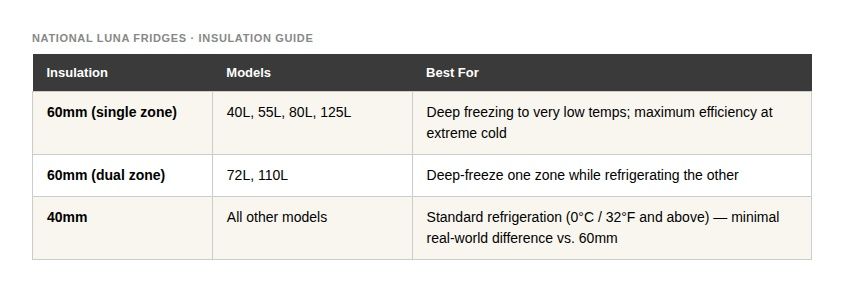
If you're running as a standard fridge (0°C / 32°F and above), the real-world power consumption difference between 40mm and 60mm walls is minimal. The 60mm advantage is most meaningful at deep-freeze temperatures.
One Simple Rule When You're Still Not Sure
If you're on the fence between two sizes, here's how to decide:
Tight on cargo space? Go smaller. Removing ice from the equation means the fridge will carry far more actual food than an equivalent-sized cooler. You'll likely have more room than you expect.
Have the space and travel with others regularly? Size up. A fridge that's too small is a daily inconvenience on a week-long trip. A fridge that's slightly larger than you need is easy to live with.